HIGH-FLYER | AI BLOG

New Releases

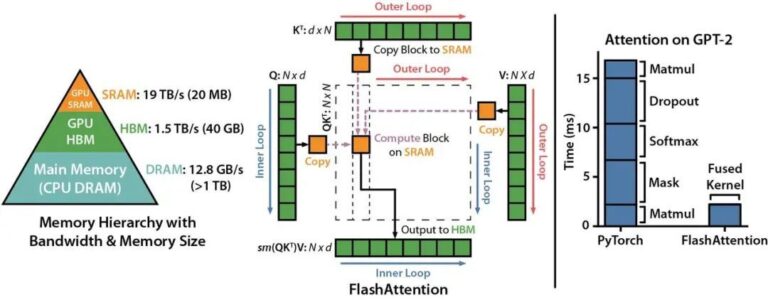
FlashAttention: A Novel Attention Algorithm with IO Awareness, Fast and Memory-Efficient

At the heart of the Transformer model is the self-attention mechanism, which has both time and storage complexity at the O(N2)O(N2) level in terms of sequence length. As the scale of large language models (LLMs) continues to grow, equipping LLMs with longer contextual backgrounds poses a significant engineering implementation challenge. A team of researchers from the Department of Computer Science at Stanford University and the State University of New York at Buffalo has published a novel attention algorithm called FlashAttention, which not only has a longer context than PyT
haiscale | Huafang Firefly High-Performance Parallel Training Toolkit

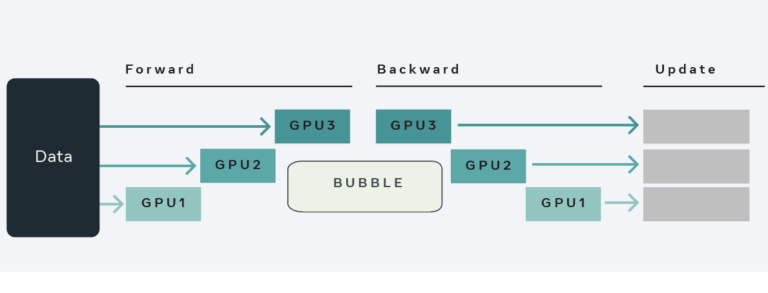
haiscale (Highflyer AI Scale) is a lightweight, high-performance parallel training toolkit that integrates Huafang AI’s years of experience in parallel training research, development, and optimization, enabling PyTorch users to train models on large-scale clusters more efficiently and conveniently. haiscale includes the following tools: haiscale.ddp: a distributed data parallelism tool that uses hfreduce—a communication protocol developed in-house by Huanfang AI—as its backend, offering better multi-GPU scalability compared to NCCL.

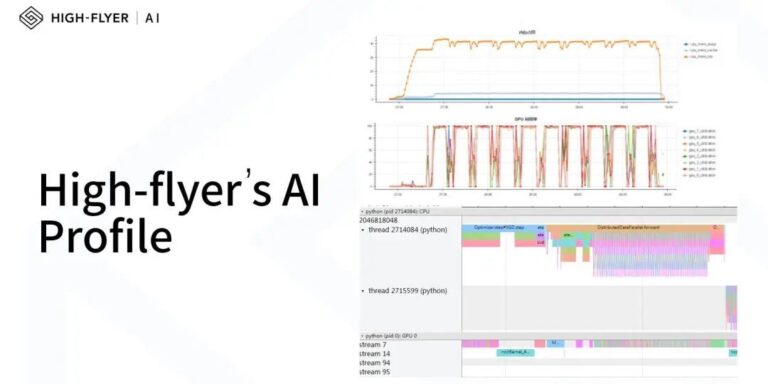
haiprof | Model Training Performance Analysis Tool

The entire world is crunching the numbers on GPT’s training and inference costs, to the point where Microsoft couldn’t wait to share the good news that “inference delivers twice the performance per dollar.” The message this conveys is perhaps this: even the slightest waste of computing power can be fatal in this AI race. As this field continues to evolve, the efficiency of model training is increasingly becoming a challenge that researchers cannot afford to ignore. Whether from the perspective of accelerating training to test more parameters or reducing R&D costs, inefficient training has become unacceptable. What researchers need now is a set of user-friendly model performance analysis tools,

GTC 2023 | On-Demand AI Computing Power II

“Don’t miss the defining moment of AI”—this NVIDIA GTC tagline has been trending across the internet since Wednesday. As is customary, the conference featured a series of cutting-edge technology announcements by the familiar face of Jensen Huang, focusing on AI, chips, and other technologies. This year, Huanfang AI was once again invited to deliver a technical presentation at the NVIDIA GTC 2023 conference. Since 2019, to meet the massive computing power demands of our own research work, we have gradually built the Huanfang Firefly Deep Learning Computing Platform, which includes storage, networking, and related infrastructure, as well as time-sharing scheduling.

HAI Platform: An Open-Source AI Training Platform

With the rapid development of large AI models, many companies have begun building large-scale deep learning training clusters based on GPUs. As computing power demands grow, an AI platform capable of centrally and efficiently managing GPU resources is increasingly becoming a key tool for AI teams to reduce costs and improve efficiency. Building an AI platform capable of managing the resources of a large-scale GPU cluster primarily involves addressing the following challenges: Resource Scheduling: As computing power continues to expand and the computational demands of training tasks vary widely, how can the relationship between tasks and computing power be managed to maximize cluster resource utilization?

CC_Cleaner: A Smooth, Efficient, and Easily Extensible Data Cleaning Workflow

AGI is the perfect embodiment of data × algorithms × computing power, and the elegant art of research + engineering + organization. In the preliminary stages of training large models, big data cleaning serves as the foundation of data processing. Take the Common Crawl dataset as an example. It is readily available on Amazon and is a free, petabyte-scale web crawler dataset that includes data collected over more than 12 years: raw web page data (WARC), metadata extracts (WAT), and text extracts (WET). How to handle the vast and complex raw data

HAI-LLM: An Efficient and Lightweight Tool for Training Large Language Models

To better leverage the computational power of GPU clusters and train powerful, trillion-parameter models with remarkable capabilities, an efficient and streamlined large-model training tool is essential. Huanfang-Basic Research has recently developed a deep learning training tool called HAI-LLM, which implements four parallel training methods: data parallelism supported by ZeRO, pipelined parallelism, tensor-slicing model parallelism, and sequential parallelism. This parallel processing capability adapts to the needs of different workloads, supporting ultra-large models on the order of trillions of parameters and scaling to thousands of GPUs. Based on the characteristics of the Firefly cluster, the in-house developed ha